
Before the fork, finger food
A recipe for Baby Squash Timbale in Broth

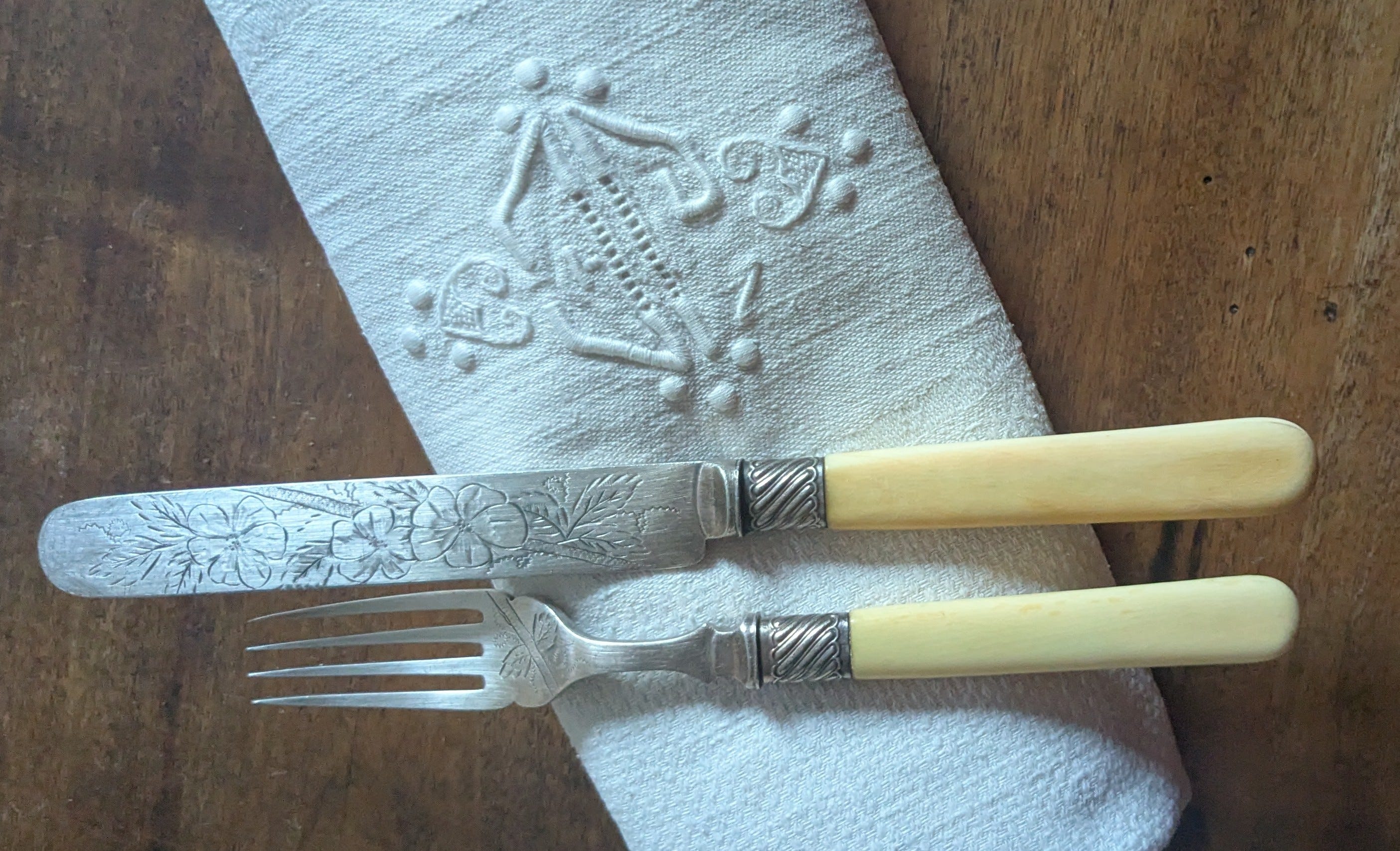
I have a confession. When I’m eating on my own, no eyes observing, I use the smallest knife and fork in my cutlery drawer. They are a size generally assigned to children, or laid for cheese, or pudding - that British final course not an American custard. I’ve come to feel that just as a beautiful glass can elevate the taste of a pricey cocktail or rotgut wine, so can what you decide to eat with improve a meal. Then a friend confided that when left to her own devices, she, too, lays herself a small knife and fork. I am not alone.
The use of cutlery of any style is a provocative matter. I empathise with those for whom chopstick control is like manoeuvring a supermarket trolley with a wayward wheel. But Chinese feasts taste so much less mouth-watering when eaten with a knife and fork. It took me a long time to overcome my disappointment at the lack of them in Thailand in favour of spoons and forks.
Utensils have always been contentious. When the Greek niece of Byzantine Emperor Basil II, Maria Argyropoulina, was married in 1004 to Giovanni Orseolo, son of the Doge of Venice, its head of state, she horrified the Venetian oligarchy by using a golden two-pronged fork she had brought in her dowry to spear the morsels her eunuchs chopped her food into. While an early version of the fork must have been known, having long been used in cooking and ceremonies by the Ancient Egyptians, a prominent Venetian cleric apparently proclaimed, “God in his wisdom has provided man with natural forks - his fingers. Therefore it is an insult to Him to substitute artificial metal forks for them when eating.” When she - and her husband and their son - died two years later of the plague, it was considered God’s vengeance.
I slightly empathise with the priest. As diners across the Middle East, India, and Africa know, food eaten with the fingers tastes so much more delicious - roti with dhal, fufu with stews, kota and kebabs and more, and in other zones a gnawed chicken leg, those last flakes pried from behind the gills of a fish, spring rolls, spare ribs, tacos, shrimp, a Silver Queen corncob dripping with butter…The list is endless.
Only when Catherine de’ Medici, wife of Henri II of France, brought home souvenir forks from a trip to Italy did they become fashionable. (Me, I ferry home quarter wheels of Parmesan). But with just two tines, they weren’t much use for conveying any range of foods to the mouth until the early 1700s when the canny Germans added extra prongs.

As to knives, those have a much longer pedigree, starting off as sharpened flints, man’s earliest tools. They didn’t really transform into useful utensils until around 3000 BC, the Bronze Age, when copper mixed with tin created a harder metal, allowing for long tapered blades with sharp edges.
Right until the late 16th century, you brought your own knives with you when invited out to dine. But their use encouraged table manners Cardinal Richelieu of France disapproved of. Guests picking their teeth with their hunting knives provoked him to rule that any knife to eat with should have a rounded end et voilà! the dinner knife was created. And also the fork. Because without the hunting knife’s sharp point to spear their meat to gnaw at like a lollipop, diners required some implement to hold it down to cut into it.
Still, it took centuries before any such elegant dining equipment reached the poor, and then only from 1913, once Sheffield metallurgist Harry Brearley revolutionised the cutlery industry with the invention of stainless steel, making it affordable for all.

It’s not only cutlery that is controversial but crockery, too. In Britain, use of a trencher avoided any need for implements. From the French tranchier, to carve, a trencher was a hollowed out chunk of stale bread, filled with stew or thick pottage for so-named ‘trenchermen’ to carry off to work with a basic spoon, and consume the container along with the food. (Even today in the north of England, enthusiastic guzzlers are known as ‘hearty trenchermen’.)
While trenchers also served as bowls for the wealthy, they would not deign to eat them but passed them munificently along to their servants, or poorer households, or to their animals. Only during the later Elizabethan era did trenchers begin to become replaced by bowls of wood and pewter, or precious metals for the aristocracy and royalty.
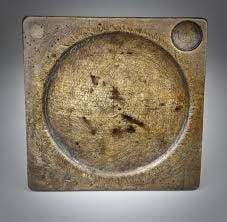
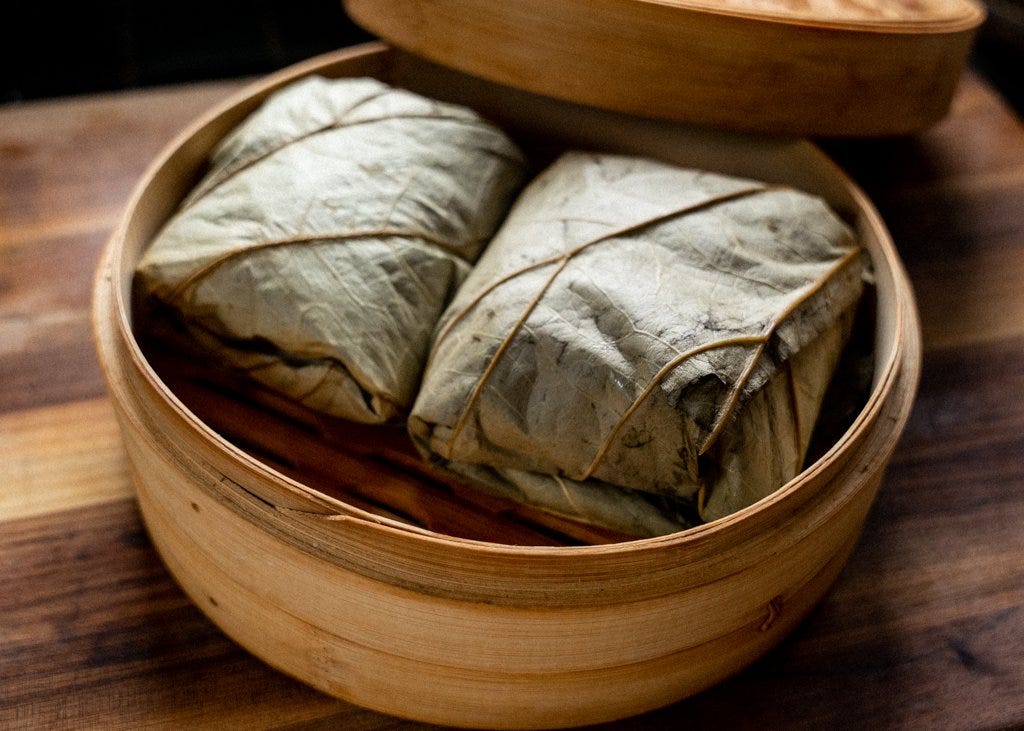
Once china and porcelain became more widely affordable from the 17th century on, trenchers were abandoned in favour of crockery - and eventually to present-day restaurant trends which have led to things to eat off like shovels that are patently absurd. But travel across South and South East Asia, Polynesia, Melanesia and Latin America and your food is very likely to be served on or in a leaf. Corn-based tamales, originally created by the ancient Mayans and Aztecs of Mesoamerica, are enfolded in banana leaves, as are the pasteles of the Caribbean and Puerto Rico. Originating in Canton, stuffed sticky rice lo mai gai, one of my (manifold) courses in My Last Meal On Earth, are wrapped in lotus leaves.
In India and Nepal, leaves from the banyan tree are sewn together to create eco-friendly disposable bowls and plates that sell for absurd sums in western ‘shelter’ stores.
Trenchers aren’t a thing consigned to the past. Consider what you do with that courgette/zucchino you never noticed expanding under its leaves in your vegetable patch until it morphed into a torpedo. The only possible way not to waste it is to stuff it with meat or rice or both. Marrows and pumpkin and squash are grown deliberately to use them as trenchers.
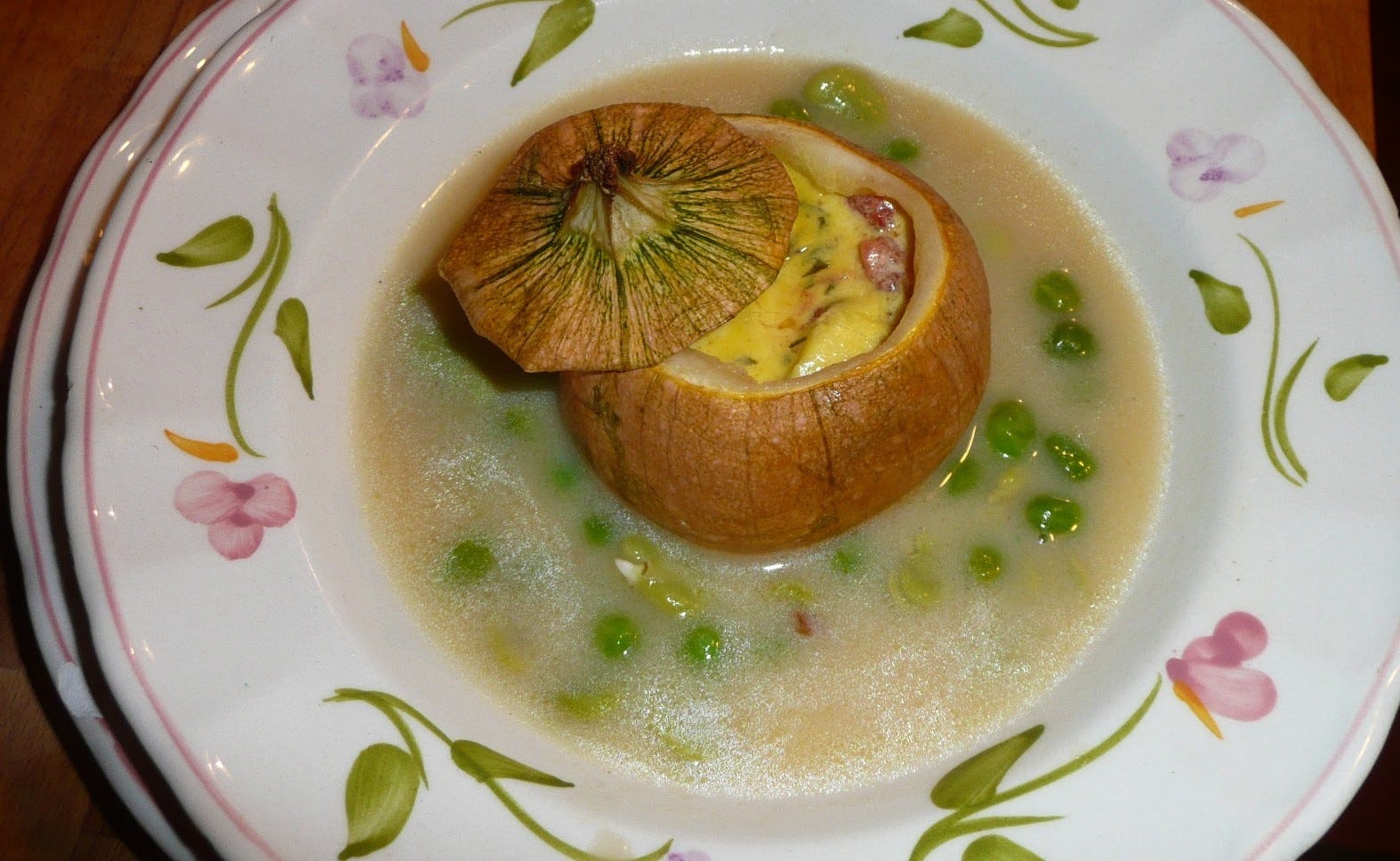
In this season when little squash are the most vibrant vegetables in stores and markets, I turned some into edible trenchers. But because I served them in a post-Christmas turkey bones broth, they couldn’t be plated up on a leaf and did need cutlery. The squash contained a vegetable timbale, a savoury egg custard. You can use any vegetables languishing in your fridge, diced. I’ve not specified how to make a broth. I’m sure you already know. Nor have I much detailed more than the principle of the timbale, for the same reason. But basically, it’s quiche-filling liquid.
To serve 6
1 cup milk
2 eggs, lightly beaten
⅓ cup Parmesan, freshly grated
Finely dice any vegetables. If you use cherry tomatoes, keep them whole so their juices don’t dilute the custard. Personally, I’d add those whole to the broth to deliver colour. In my timbale, I used a few peas, broad beans, diced zucchini, al dente broccoli florets, some diced ham and slivers of the walls of the squash.
Preheat oven to 200C/400F.
In a bowl, beat together the milk, eggs and Parmesan. Slice a lid off each squash and reserve. If they are particularly thick, once you’ve deseeded the squash, hollow them out a little and finely chop the flesh to add to the filling. Slice off a sliver from their bottoms to allow each squash to stand up.
Add your vegetables to the custard and carefully pour into the empty squash, more vegetables than liquid, whose function you should consider similar to wall-fill. Replace each lid. Crumple up some aluminium foil and coil to create a support in which to stand your squash so they don’t tumble during the cooking. Put these into a baking pan. At this point you can chose from one of the following cooking methods. Carefully wrap each squash in more foil before setting them onto the crumpled foil then pouring boiling water a third of the way up the pan and baking for 30-40 minutes depending on size. Test for done-ness through the foil with the point of a knife. Or you can simply set them on the foil coil and roast them naked. Or, having set them up, tent the baking pan with foil. I’ve done them all ways, using that last method when I’ve made double or more of the amount. Test for softness of flesh after 30 minutes.
On the stove top, bring to a simmer your turkey broth and add your peas, beans, cherry tomatoes, slivers of mushroom or other vegetables to make a delicious soup.
Once the squashes are cooked and unwrapped, ladle some broth into warmed bowls, and set one in the centre of each.
Loved the Maria Argyropoulina story Julia. The Venice cleric's reaction perfectly captures how intensely people resist new eating tech, even tho it seems ridiculous now. Funny how the fork went from being seen as an insult to God to becoming the mark of refinement within a few centuries. The trencher concept is genius from an efficiency standpoint, edible plates basically solved the dishwashing problem before ceramics became affordable. I tried eating Indian food with my hands last year after years of using forks and the flavor difference was actually noticeable, must be someting about direct contact or maybe just slowing down the eating process.
This was wonderful!