
Peas that please
A recipe for Chicken with soupy peas and lettuce


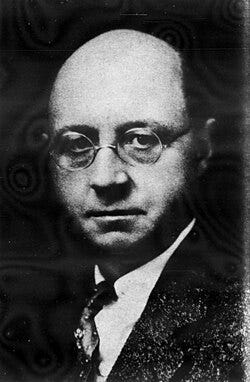
There’s one vegetable that’s almost better frozen than fresh: the pea. An early 70s advertising jingle for frozen peas based on that view starred a very young Patsy Kensit - long before she married Liam Gallagher of Oasis (obviously) followed by three further musicians: “Sweet as the moment when the pod went pop!” The brand was Bird's Eye, named after Clarence Birdseye, the American entrepreneur and inventor considered the founder of the frozen food industry who, in 1952, was the first person to freeze peas.
Of course, if you grow your own, there’s nothing to touch peas picked from the vine and immediately boiled and buttered. Those leathery-looking pods in high-end grocery stores that cost the price of a rare treat really aren’t worth the investment. It’s been days since they left the field and left languishing in crates. Just like sweetcorn, peas begin to develop their starch as soon as they’re separated from their stalks. Boiled, they turn into bullets, and floury to the bite. Those peas would be better used turned into the Dutch split pea potage that is cooked with a hock of ham, but it’s hardly a springtime soup.
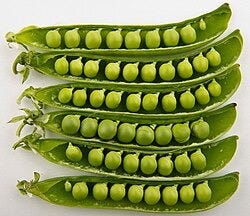
The ultimate pea-experience method for cooking just-picked peas, I would suggest, is the edamame method: melt enough butter to generously fill a small saucer for each diner, then steam or boil the peas in their pods. Holding them by their stalks, dip each pod in the butter, nip the end between the teeth to open them and release the peas and their juices, then finish them off like a globe artichoke leaf, dipping the pod back in the butter and drawing it through clenched teeth to ease the pod’s softened flesh from its fibre.
My father grew peas in rows under netting so that we, not the birds, would benefit from the crop. In early spring, as their first shoots emerged from the winter earth, we would trudge through the woods to cull pea sticks - young branches with a network of twigs for the peas to curl around and grow skywards. Once they had turned into the green thicket that fed us spring and summer long, my sister and I would toss for one of the two supper jobs - laying the table or podding the peas - to be completed before we could escape briefly back to the garden.
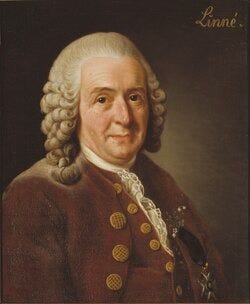
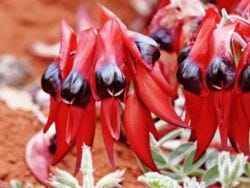
Peas owe their name to Swedish biologist and professor of medicine and botany at Uppsala, Carl Linnaeus. The father of modern taxonomy, he classified plants, animals, and minerals, coming up, in 1753, with the name ‘Pisum sativum’ from which we derive the word ‘pea’. The challenge for clarity, though, is that so many very different legumes are known as a pea, peas which aren’t necessarily round and green: the pigeon pea or toor dhal of South East Asia, the cowpeas of Africa, and black-eyed peas which are another type of cowpea and originated in West Africa. These were introduced into the West Indies and the American South by enslaved people in the 17th century. Then there is Captain Sturt’s desert pea, an ancient and beautiful herb of Australia whose flowers too are edible.
If you are a regular reader of Tabled, you'll not be surprised to learn that peas are historical. According to archaeological finds across the area now separated into Syria, Anatolia, Israel, Iraq, Jordan and Greece, peas go back to 7000-5000 BC. They show up in 5000 BC in Georgia, then in the Nile Delta from around 4800 BC, and a century later in Upper Egypt. By 2000 BC they’re found in Afghanistan; after that in northwestern India, and so on and onwards and on. By the 4th century BC, peas are so prolific that Theophrastus, the Greek philosopher commonly considered the father of botany, gives specific growing advice in his Enquiry into Plants.
Our familiar Pisum sativum, also known as the garden pea, and the flat, immature pod of the mangetout or snow pea that is eaten whole, together with the sugar snap pea which is a cross between the garden pea and the mangetout, are each of them pods from the same family. While we loosely think of peas as vegetables, their proper category is a legume. Once they have been dried, they become known as pulses, like split peas and lentils. Packed with fibre, iron, potassium, and magnesium, they are good for winter soups and mushy peas, the essential side to fish and chips.
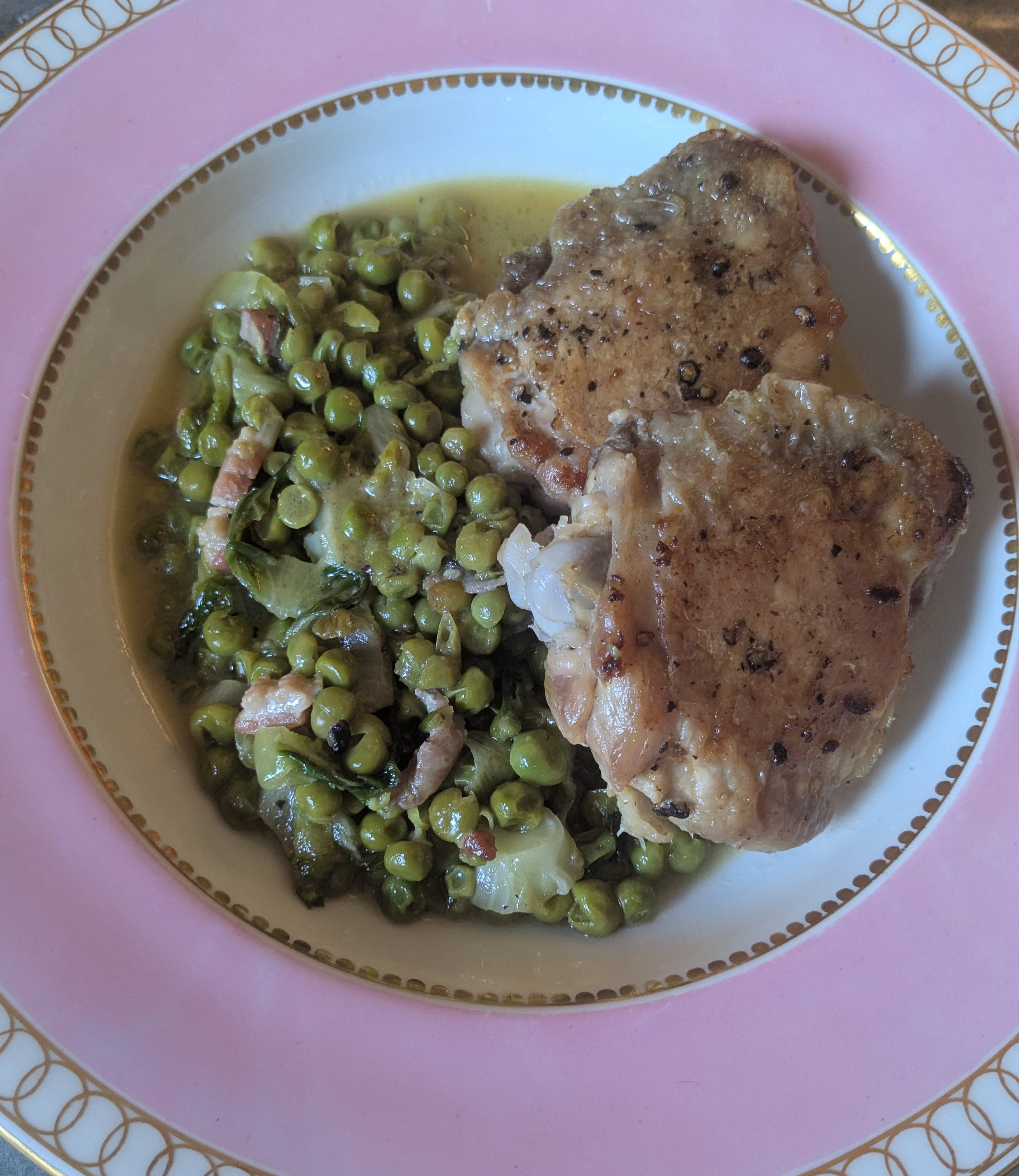
Contrary to what I said at the very beginning, this recipe can be made with those pricey bullets sold in their pods. It has been pinched from London’s Quality Wines and its chef, Nick Bramham, and can be created with great success with frozen peas, which is what I always cook with. It takes the French manner for cooking peas with lardons and lettuce to make a one-pot chicken dish that is so much greater than the sum of its parts, buttery and rich.
Serves 2
800g fresh unpodded peas or 200g frozen
1 teaspoon olive oil
30g unsmoked lardons
4 large chicken thighs, bone in, skins on
sea salt and freshly ground black pepper to taste
3 spring onions/scallions, trimmed, cleaned and sliced 5mm thick
2 cloves of garlic, bashed
water
30g cold butter in cubes
1 Little Gem/Romaine lettuce heart, thinly sliced
splash of white wine vinegar
Shell the peas, if using fresh. Gently fry the lardons in the olive oil until crisp, golden and smell delicious enough to tempt vegetarians (I say this because my vegetarian friends all say that bacon is the only animal product that makes them waiver). Remove the lardons, but keep the rendered fat in the pan.
Season the chicken thighs with salt and pepper. Gently fry them skin-side down in the rendered fat over a low-moderate heat until the skin is crisp and deep golden brown (approximately 15 minutes), then turn and fry on the underside for five minutes.
Add the spring onions and garlic and swirl around in the fat for a few minutes to soften but absolutely not take colour.
Add the lardons and peas and enough water to come halfway up the chicken thighs, then simmer very gently until the peas are completely tender, an unfashionable dull green colour, and the broth has reduced to just about cover them (approximately 45 minutes).
Plate the chicken thighs. Discard the garlic from the broth, stir in the butter, add the baby gem and allow it to wilt while still retaining some bite. Add a splash of vinegar and adjust the seasoning and acidity to your taste. Spoon the peas and their sauce over and around the chicken.
I have made what were called in the recipe I followed “French peas” that way before but never thought of combining them in the same pot with chicken.
So thank you for the idea and the recipe, as well as the fascinating history lesson!
Not a big fan of peas in soups. My fav use of them is in chicken salad. Braised chicken breast cut up added to food processor. Add red onion and celery. Add chopped apple. Briefly chop. Put in bowl and add thawed package of peas. Add mayo to bind. Great by itself or a filler for sandwiches or lettuce wraps.