
Just peachy! Or just flat?
A recipe for Caramel Peaches with Vanilla Cream and an extra for Hazelnut Sauce

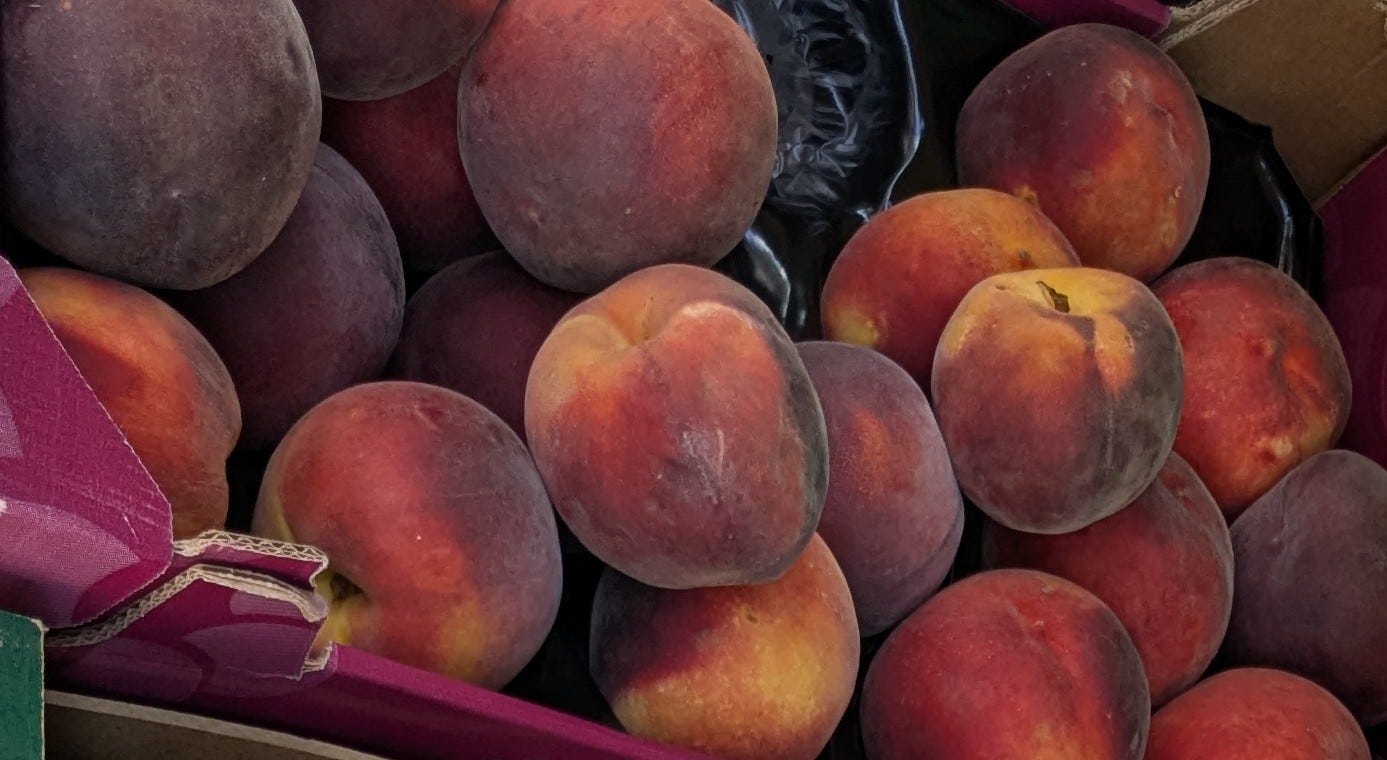
I realise I must be a bit of a bigot. For years, I’ve looked disparagingly upon what’s apparently called the donut peach. What is their point, I’ve thought. I considered them the fruit equivalent of the Brazilian butt lift. Alright for some, but is it really of long-term benefit to fiddle about with Nature? I never saw their point, and thought them a bit pretentious. So whenever there was a choice in a store between the conventionally round and the shape that takes its form from a loft-dweller’s cushion, I avoided them.
But now they’re everywhere. So on holiday in Greece last week, I took some down to the beach. I have to admit, they’re very handy for a beach. If you elect not to bite straight into them but to cut them, you can twist the two halves and easily release the fruit from its tiny stone. On the other hand, it is always wonderfully indulgent to sink your teeth into the flesh of a round ball peach that clings tightly to its pit and feel the juice running down your chin. Fine on a beach with the sea close by to wash it off but not so accommodating at picnics when you’ve already run out of napkins.
My assumption that donut peaches were merely the result of scientists fiddling with the original peach in order to produce another shape to satisfy a fickle market is completely incorrect. They are not at all genetically modified. They have been around for centuries.
The donut originated in China as the pan tao peach or ‘coiled peach’, in the garden of the Queen Mother of the West. She was an ancient Chinese goddess living on the mythological Mount Kunlun who cultivated these ‘peaches of immortality’ that granted longevity to those who ate them. Given its genesis lies entirely in fairytale, this proof of the donut having been around for centuries can’t by any stretch of the imagination be called authoritative because it is imagination.
All the same, lack of concrete evidence didn’t prevent the pan tao or peen to being referred to in Chinese writings over 2000 years ago. A touch more recently, a 16th century novel, ‘Journey to the West’, has the Jade Emperor making the Monkey King, Sun Wukong, the Protector of the Heavenly Peach Garden. When Wukong eats most of its fruits, he gains eternal life. There, see? Irrefutable corroboration of the donut peach’s early existence.
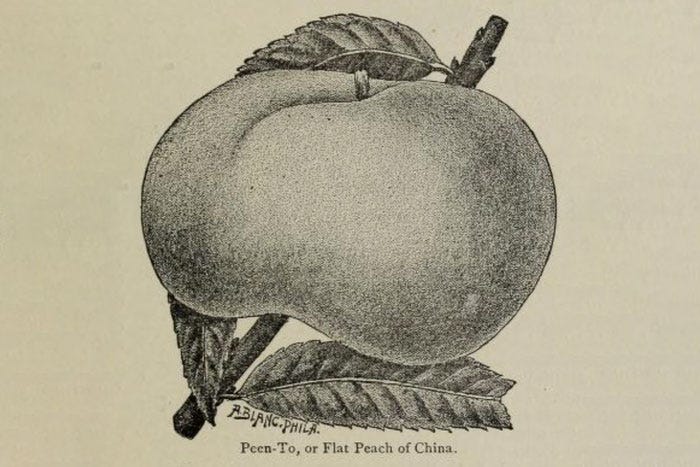
The flat peach must have existed in reality because back in 1828, William Prince, who established the first commercial nursery in the United States in Flushing, New York, imported twenty ‘peen to’ trees from China. Then Prosper J. Berckmans, owner of Fruitland Nurseries in Augusta, Georgia, competed with his import of ‘peento’ seeds from Australia. But from either nursery, trees were only for the privileged gardener. Tree seedlings cost 50 cents each as against the traditional round-peach tree seedling which only cost 15 to 25 cents.
Peentos didn’t become mainstream until after the 1960s when scientists at Rutgers New Jersey Agricultural Experiment Station, who had hybridised the plants to produce hardier trees and called their bigger, sweeter fruits the ‘Saturn’, sold the license to grow the trees to Stark Bros’ Nurseries & Orchards Co in Missouri. The peach’s launch into the mainstream occurred in 1986 when their fruits went on sale at Frieda’s Specialty Produce, the Los Alamitos, California company that introduced speciality stuff like kiwis, alfalfa sprouts, spaghetti squash and so much weird more to the American market.
It was Frieda Caplan who christened it the ‘donut’ peach. As soon as the Stark Bros’ exclusive license expired in the early 2000s, the market for the flat peach rocketed. Now there are around 20 different kinds of donut peach in the US alone, with many more types sold in other parts of the world.
What would Edward VII have made of them? A fan of regular round peaches, when dining in Paris incognito, or so he thought with the insurance of an HRH, with a very attractive young woman, he was taken aback by the elevated price he was charged for the fruits. He queried his bill. “Peaches must be very rare this year,” he observed. “Yes, sire. But not nearly as rare as kings,” said the waiter. The monarch paid up.
Next up? The flat nectarine. I kid you not. The New Jersey Breeding Program has already grown and distributed it through California’s Family Tree Farms as the nectapie. Yesterday, I saw one at three times the price of the round one that was on sale next to it.
While the Saturn/donut/paraguayo/pan tao/saucer/flat/belly-up/UFO/Chinese flat/hat/anjeer/custard/wild/white/pumpkin/squashed/bagel or pita peach is a juicy competitor to the conventional round peach, it isn’t so versatile as a dessert. You can, of course, do as many Europeans do to the round: just slice it into your glass of red wine at the end of the meal. But not much more. And, anyway, why wouldn’t you just want to eat it as it is?
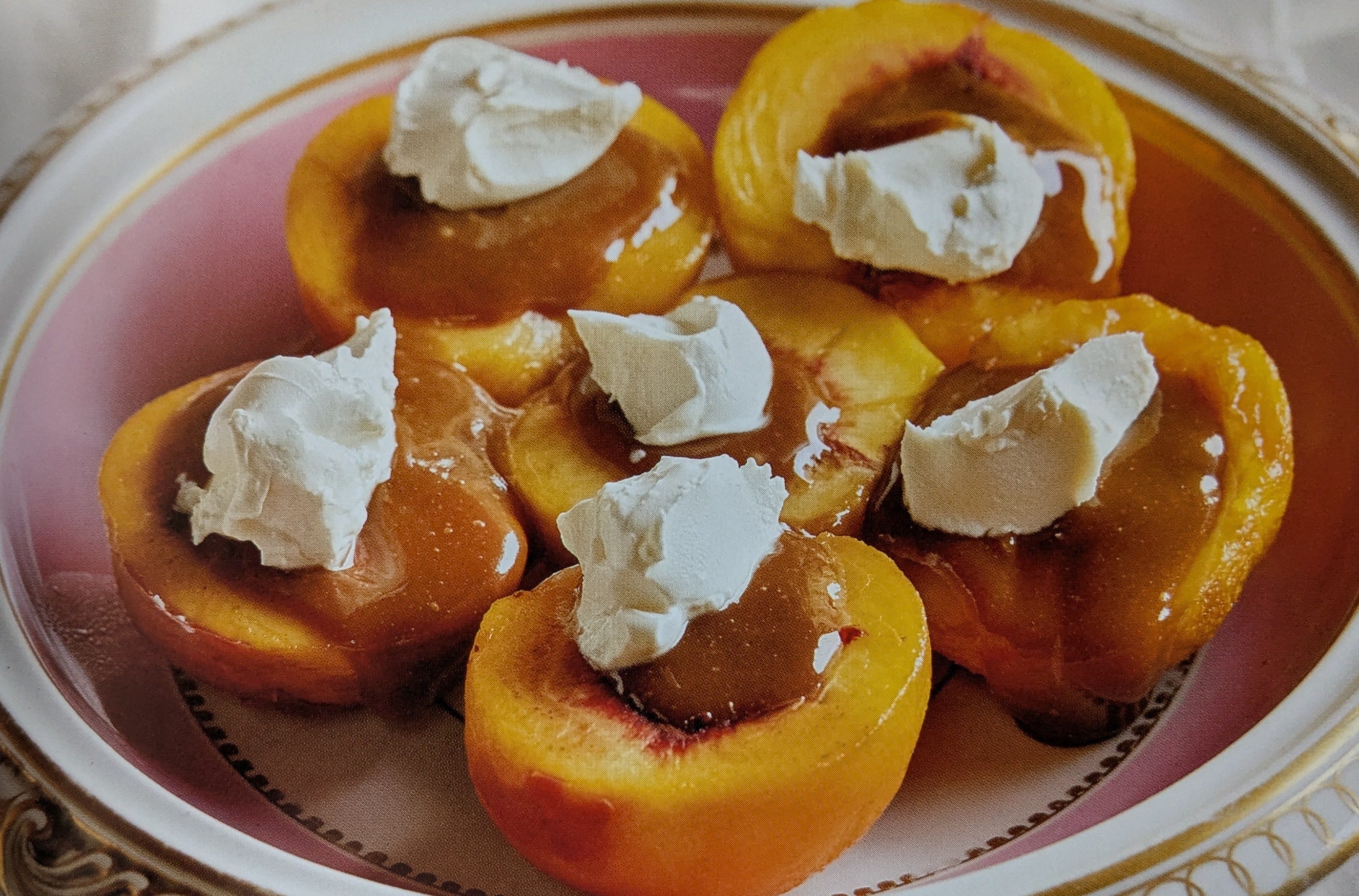
But as to the round peach, even less than celestial ones are made almost heavenly served this way:
Serves 4 or 8
4 large peaches
Put peaches into a large bowl and pour over a kettle of boiling water. Wait 1 minute then drain. Peel, cut peaches in half and remove their stones. Place one or two halves cut side up in 4 or 8 bowls.
For the caramel sauce:
100g/3oz sugar
120ml/4 fl oz double/heavy cream, warmed
3 tablespoons butter
For the hazelnut praline sauce:
300g/10 oz toasted hazelnuts, skins rubbed off
340g/12 fl oz clear honey with good flavour
Put peaches into a large bowl and pour over a kettle of boiling water. Wait 1 minute then drain. Peel, cut peaches in half and remove their stones. Place two halves cut side up in 4 bowls.
For the caramel sauce:
Melt sugar in a medium saucepan over medium-low heat, swirling pan occasionally but not stirring, cooking until sugar is uniformly dark amber. Remove from heat. Slowly pour in warm cream, stirring with a wooden spoon to combine. It will sizzle. Stir in butter. Return sauce to low heat and cook, stirring constantly, until smooth, 5-10 seconds. Let cool.
For the hazelnut praline sauce:
Grind the hazelnuts into a fine paste in a food processor. Add the honey and blitz again quickly to incorporate, or pour ground hazelnuts into a bowl and stir the honey in with a wooden spoon, then store in jars.
To serve, reheat caramel or hazelnut praline over low heat for a few minutes, pour over peach halves and serve with a spoonful of Vanilla Cream or crème fraiche on top.
Both sauces can be stored in a covered jar in the refrigerator for at least 1 month.
For your own healthy-ish palm-oil free Nut spread, melt 150g-300g/5-10 oz 70% chocolate bar (the quantity depends on how strongly you want to flavour the nut paste) and add it to the hazelnuts and honey in the food processor, and you produce a sumptuous familiar spread for smearing over slices of fresh baguette or hot toast.
Vanilla Cream
This makes a seductive alternative to cream or crème fraîche that’s also good served with chocolate cake and more.
Makes 200g/7oz
120ml/4 fl oz heavy/double cream
80ml/2¾ fl oz mascarpone
2 tablespoons icing sugar, sifted
1 teaspoon vanilla extract
Whisk together cream, mascarpone, icing sugar and vanilla until the cream holds stiff peaks and spoon into each peach half’s cavity.
Julia, this is lovely and so informative. Here's another name to add to your list: pesca tabacchiera, as they're called in Sicily, which I translated as tobacco box peaches but more recent research reveals the true translation: snuffbox peaches. Indicating they date back in Sicily to a time when gents (and ladies too occasionally) never went out without a silver snuffbox. And that was probably long before Frieda came across the peaches.
That waiter line is terrific.