
Eat like a bird
A recipe for healthy seed crackers and a no-knead loaf


Our avian friends know a thing or two. Gone are the days of humans extracting a bolstering diet from the fresh vegetables and fruits, wild fish and free-ranging beasts of earlier generations. Our diminishing required nutrients are provided instead in the ‘enhanced’, ‘enriched’ products of Big Food Biz.
Or seeds.
During the 1980s, the must-have but questionable interiors accessory was a terracotta creature - a ram, hedgehog or capybara. You’d fill it with chia seeds, wet it, and lo! In a transforming week or two, a green animal would emerge for which ‘whimsical’ and ‘kitsch’ are not adequate adjectives.

These days, the container for chia and other seeds is us. The elevation of seeds to “superfood” status has developed a market which has steered them from worthy health snack into mainstream ingredient, to be drifted over everything from your morning muesli to salads and any dish from the Middle East - although aside from sesame seeds, they’re not quite so exuberantly scattered in that part of the world.
Why are we aping birds?
High in fibre and omega-3 fatty acids, chia seeds will manage our blood sugar levels, improve our digestion and heart health and make us feel full. A mere two tablespoons of them, apparently. Impressed? Ditto flaxseeds, preferably ground because their potent alpha-lipoic acid (ALA), a water- and fat-soluble antioxidant, lies in their outer shell, which isn’t easily digestible. Pumpkin seeds, too, are high in antioxidants. Dense in protein, magnesium, and zinc, they maintain blood pressure, the immune system and the heart. Hemp seeds are stuffed with protein, amino acids and vitamins E, D, and A. Sesame seeds are key to bone health as well as providing copper, iron and B vitamins (which sunflower seeds also deliver), vitamin E, protein and the ‘good’ fats.
Aside from some seeds provoking anaphylaxis or other allergic reactions in vulnerable eaters, the treasure that all of these provide is fibre.
In the UK, more than 90 percent of adults don’t eat enough of it. We’re supposed to consume 30 grams of dietary fibre daily. Most of us only manage 18 grams. In the USA, it’s even less - 15 to 16 grams per day.
30g of fibre is a lot when you consider 2 slices of wholegrain toast provide a mere 4g and a banana or an apple 1g. A cup of cooked brown rice delivers 1.8g-3.5g. White rice less than half that. Half a standard tin of tinned baked beans (could you eat that much of them?) delivers 10g from 200g/7oz, and 80g/2¾ oz of cooked chickpeas just 4g.
Rough(age)ly speaking, with any of these generous helpings you’re around 25 grams or more short.
Fibre deserves more respect. It brings to the party the latest celebrity in our aspirational self-care vocabulary: a healthy gut microbiome. This trending health goal trumps hands down seed attributes without nearly the same caché, such as assisting digestion, preventing constipation, lowering cholesterol, controlling blood sugar levels, and reducing the risk of heart disease, type 2 diabetes and certain cancers, all fibre’s talents which manufacturers do not elect to blast across their packaging.
No wonder, perhaps, that more than 70 percent of UK adults buy dietary supplements, a market worth between £650 million/$868,169,250 and over £1 billion/$1,335,450,000, depending on how many other ‘wellness’ products are included. In the US last year, it was valued at $68.74 billion/£51.10 billion and is predicted to top $131 billion/£98,143,890,000 by 2033. Though UK figures haven’t been established, in the US there are over 29,000 different dietary supplements available, with around 1000 new ones introduced each year. If we need any evidence there’s something wrong with our food, this surely is it.
If we were still growing fresh produce without the fertilizers and chemicals which the industrial food complex tells us are vital to maximize crop yields, guarantee consistent quality and achieve global food security (all of which is also theoretically possible if we make a significant shift toward agro-ecological methods, precision technology, and reduced meat consumption), those nutrients markets would not exist to feather the nests of their manufacturers.
So let’s copy the birds and turn instead to seeds. These crackers are delicious with a soft and creamy or a blue cheese and also on their own, as is the loaf recipe which follows.


65g/2¼ oz each of pumpkin seeds, sunflower seeds
50g/1¾ oz chia seeds
40g/1⅓ oz black and/or white sesame seeds
20g/¾ oz flax seeds
175ml/scant 6 fl oz water
70g/2½ oz finely grated Parmesan cheese
1-3 tablespoons plain/all-purpose flour
Put all the seeds with the water into a bowl and set aside for 30 minutes for the water to fully absorb.
Preheat oven to 170C/335F.
Stir the Parmesan cheese into the seed mixture. If it is in any way wet, add flour little by little and incorporate it well. But don’t over-do it.
Oil a sheet of baking parchment and press into a baking pan. Spread the seed mixture over and bake until the mixture is set and completely dry, about 55-65 minutes. Check half way through to make sure it isn’t browning too fast, which case lower the temperature.
Slide the pan onto a wire rack to cool completely. The cracker is soft out of the oven but will crisp up when it cools down. Once cold, should the cracker stick to the paper, carefully flip it over then place a damp cloth over the paper to loosen it and make it easy to peel away. Break the cracker into random pieces.
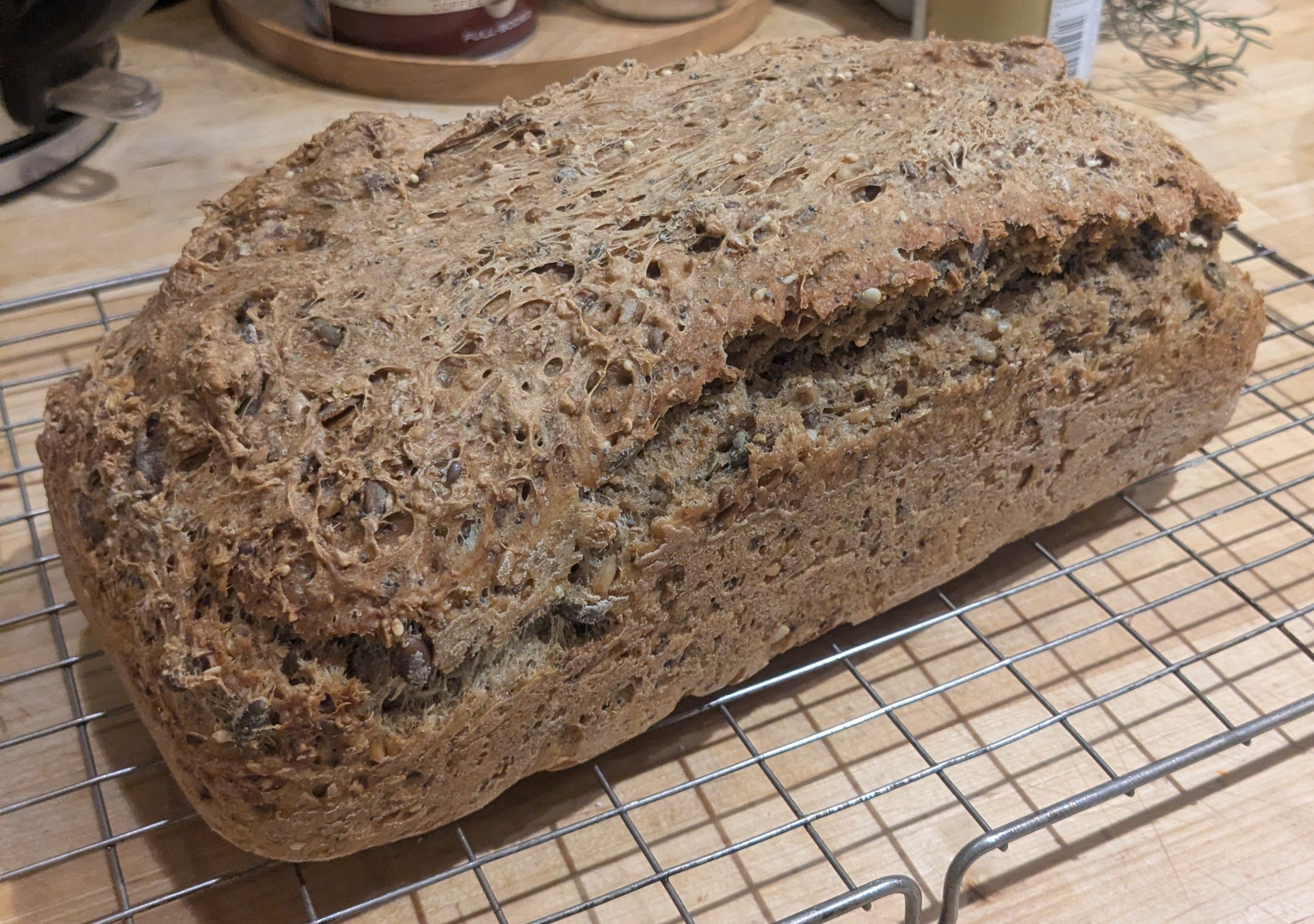
I’ve given this bread recipe before. But these days when I make it, in the light of what I now know about them, I fold in not one but two to three handfuls of seeds. Because of its long proving time, eating the loaf causes far less bloat in those who suffer.
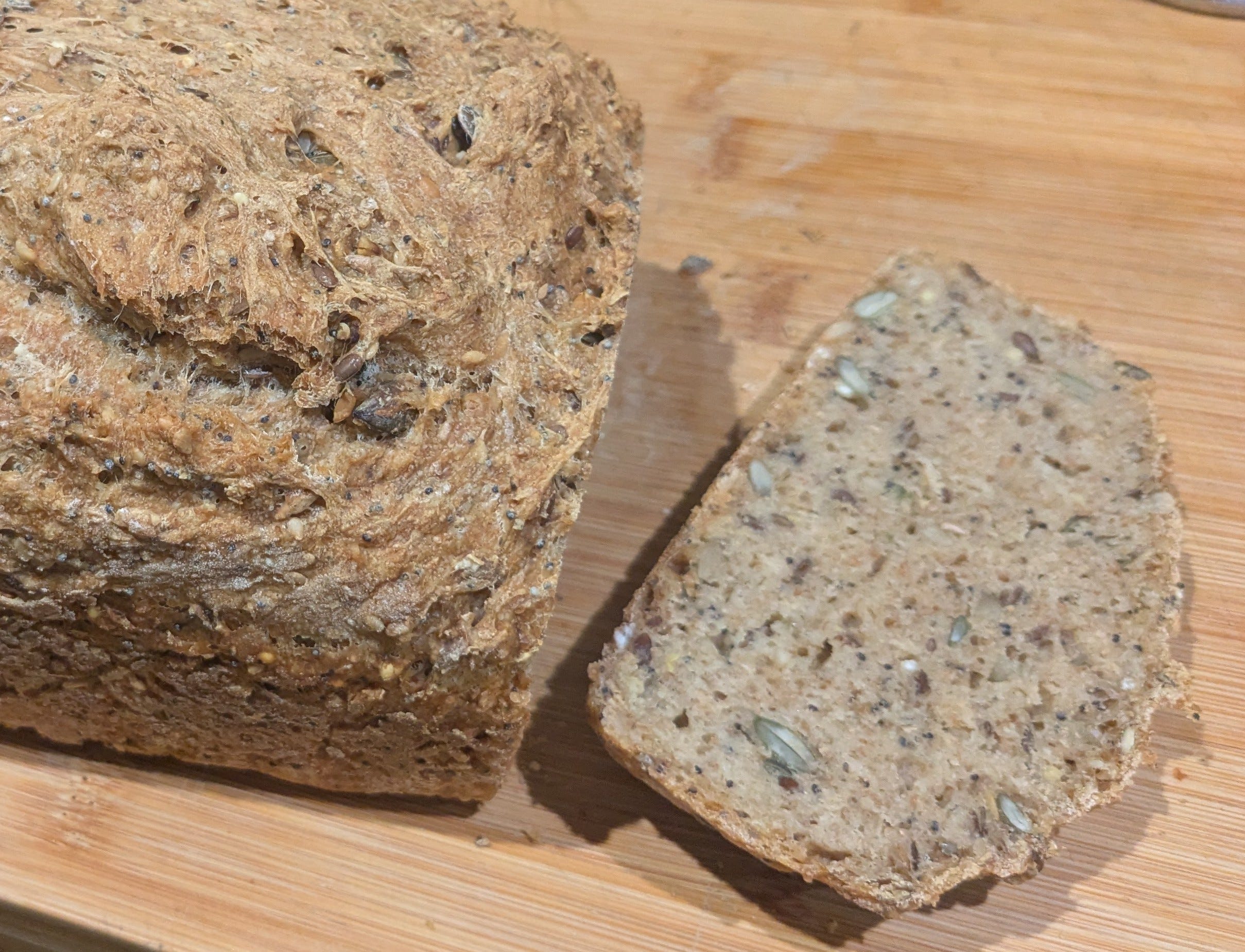
420g/14½ oz malted flour
350g/12½ oz whole-wheat flour
175g/6 oz white/strong bread flour
2 teaspoons powdered yeast
1½ teaspoons salt
generous handful of mixed seeds (pumpkin, sunflower, linseed, sesame, chia, etc)
720ml/1½ pints warm water
Mix the flours, yeast, salt, and your choice and quantity of seeds together in a large bowl. Stir in the water till absorbed. Cover with plastic wrap, and leave the dough to rise in a warm place for at least 4 hours and up to 8, or overnight.
Preheat oven to 180C/350F.
Generously grease a 1kg/2lbs loaf pan. Upend and scrape into it the bowl of risen dough without punching it down, and bake for 40 to 50 minutes. Remove from the pan and tap the base. If it sounds hollow, it’s done. If not, put it back for 5 minutes then test again. Leave to cool on a rack before slicing.
I’m in the store buying seeds and those flours for making the bread. Thank you! ….as always. I learn so much from you, and am so grateful!
Trying this loaf. I am wondering if I can work sourdough starter into it. You also inspired me to put together a batch of Chia seed pudding. It is my favorite pudding.