
Chuck that chip! It could be lethal
A recipe for Cheese Straws


You’ve relished the festive feast of Thanksgiving. Christmas jollities surge swiftly in on its heels. So, briefly in between, here’s a dash of cold-water reality to sober you I bet you know nothing about.
Daily, the media bring us life-changing news of floods, and wars, and cyber assaults, each altering the lives of their undeserving victims. But there’s one story this week I haven’t read or heard reported outside the food industry press that is life-changing for every single one of us. It may possibly shock even Santa Claus.
The prestigious medical journal, The Lancet, UK equivalent of the New England Journal of Medicine, has just published a report on a landmark investigation into Ultra Processed Foods.
Don't sigh. You need to hear its findings.
To wit: UPFs damage every single one of the organs in our bodies. Consumption of UPFs can have long-lasting health consequences throughout a person’s life.
We already know they are linked to obesity, and - what has now been formally established by The Lancet report - that UPFs are linked to a worldwide increase in diabetes. What's new is the study confirms they are also associated with the chronic and life-changing diseases Crohn’s and kidney disease, and to cardiovascular disease, that umbrella term for coronary heart disease, stroke, heart attack and high blood pressure, and also to depression.
But perhaps the biggest shock comes from the finding of a convincing link between the chemicals used in the packaging of UPFs and ‘endocrine disruption’. For a layperson like me, this means the blocking or altering by external chemicals of the body’s hormone functions. This can lead to “adverse effects” on our metabolism, development, and reproduction.
It is these “adverse effects” that The Lancet identifies that really should be headline news.
We probably already understand, if vaguely, an “adverse effect” on “metabolism”. It’s the disruption in how the body processes food into energy and which leads to obesity, high blood sugar, high blood pressure and unhealthy cholesterol levels.
What we haven’t heard before, and even more alarming, is what an “adverse effect” on “development” implies. It is the disruption of a person’s physical and mental growth. Do you have children? Do they shriek for salty snacks in colourful packages? Do you? Well, they and you probably shouldn't eat them again.

However, the really shocking finding is the “adverse effect” on “reproduction”. Anyone planning to become a future parent should attend to in particular to this. It means UPFs can cause infertility.
Is a comforting sack of kettle chips worth the risk of any of the above?
The ‘reformulation’ that Big Food Biz is undertaking to improve their products and bring them into line with regulatory limits on sugar, fat and salt is not enough, according to The Lancet. Removing harmful ingredients and replacing them with beneficial ones will not counteract the negative effects of UPFs because it doesn’t tackle their total impact. As just one example, the reduction in Chile of sugar came with a 15 percent increased consumption by children of replacement non-nutritive sweeteners linked in the past to higher mortality rates and, when present in soft drinks, to liver disease.
‘Reformulation’ is a means, The Lancet says, of “health-washing” Ultra Processed Foods to hide their negative impact behind their nutrient content. It also makes the point that fortification claims (adding beneficial ingredients like protein and fibre) on packaging can be used to distract from the potential harm of other ingredients in UPFs.
Fortification and reformulation can disrupt ‘the food matrix’. This is the name for the complex three-dimensional structure of a whole food. It defines a food’s structure and its chemical interactions of proteins, fats, fibre, and minerals. It describes how the nutrients and the other bio-active compounds a food contains are digested, absorbed, and metabolised. UPFs are more quickly digested and their calories more quickly absorbed: this explains the link between UPFs and weight gain.
In the fifteen years between 2007 and 2022, the replacement globally of traditional diets by Ultra Processed Foods with lower nutritional value increased around 60 percent not just in low income and lower-middle income countries, but in upper-middle-income ones.
The Lancet calls for coordinated global public policy to focus not only on nutrients and common UPF ingredients such as additives but to target Ultra Processed Food manufacturers and fast food corporations, marketing and promotions, supermarkets, retailers and food supply chains. Top UPF manufacturers are Nestlé, the world’s largest food manufacturer, PepsiCo, Unilever, Coca-Cola, Kraft Heinz, and Danone, General Mills, Mondelez International, and Mars Inc. Their considerable power makes reining them in an equally considerable challenge. But you can choose not to eat this junk. And tell others about their dangers.
Instead of UPF snacks that have been engineered to make you crave more, bake these cheese straws. Every ingredient in them is natural.
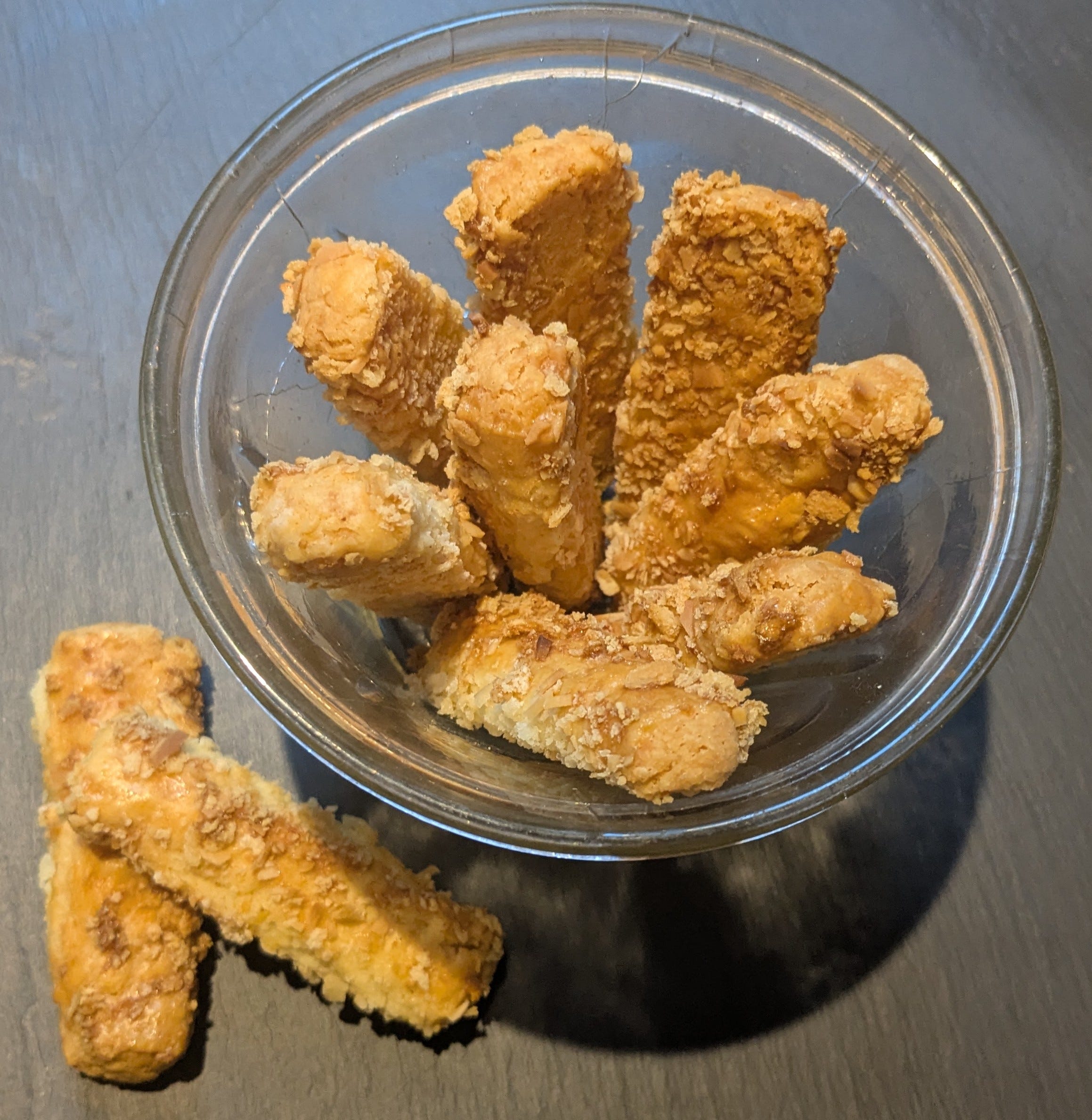
Makes about 40-50 straws
450g/16 oz plain flour
150g/5¼ oz cold lard or, in the US, Crisco
150g/5¼ oz cold butter
150g/5¼ oz strong Cheddar, grated
½-1 teaspoon Cayenne pepper, to taste
4 tablespoons iced water up to 1/4 pint
1 egg, beaten
85g/3oz Panko breadcrumbs
985g/3oz roughly chopped flaked almonds
Dump the flour in a mixing bowl. Grate the lard and butter against the large holes of a cheese grater into it then rub the fats into the flour until the mixture looks like coarse breadcrumbs. Add the cheese and Cayenne pepper and incorporate it in the mass using the blade of a dining knife.
Starting with 4 tablespoons, add just enough iced water, maximum 1/4 pint, to bring the cheesy flour into a firm dough. Wrap in clingfilm and chill for 30 minutes.
Pre-heat the oven to 200C/390F.
Bring the pastry back to room temperature and roll it out the pastry to a generous 1¼cm/½ in thick. Brush brush with the beaten egg and roll in the breadcrumbs and almond mix. Cut into rectangular strips 1¼cm/½in wide and 10-12cm/4-5ins long, and spread in orderly lines across a lightly greased baking tray. They won’t spread.
Bake about 20-30 minutes until golden brown, but check after 15 minutes as ovens vary and you may have to swivel your pan 180 degrees. Cool on a rack then store in an airtight container. These are best served warm. so heat them up again in a 110C/230F oven.
To be sure, these may not be so heart-smart, but oh! what they do for the soul. As some sage is alleged to have said eons ago, "all things in moderation, including moderation." Cook on, dear Julia. You are a culinary goddess.
On the one hand, I agree with all the scary points you've made. On the other hand, orange Cheeto dust.